Realistic Mirror Selfie AI Prompt (Indian Saree Girl) – Ultra Real Image Guide
 BeforeAfter
The Prompt
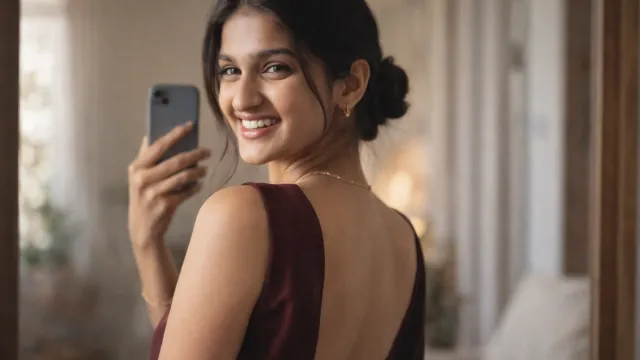
A highly realistic candid mirror selfie of a beautiful young Indian woman wearing a dark burgundy sleeveless saree blouse with an elegant deep back design, turning gently over her right shoulder with a warm, natural smile. She is holding a grey smartphone partially visible in the mirror reflection. Soft indoor home lighting coming from a nearby window creates natural shadows and highlights on her face and skin. She has minimal, natural makeup with glowing skin texture, subtle gold jewelry including earrings and a delicate chain, and her hair styled neatly in a low bun. The setting is a cozy indoor home environment with slight background blur, authentic details, and natural imperfections. Shot in ultra-realistic photography style, 4K, high detail, realistic skin texture, DSLR quality, shallow depth of field.
Ever scrolled through social media and paused—just for a second—because a photo felt so real, so effortlessly beautiful, that it almost whispered a story? That’s the magic of a well-crafted prompt. And today, we’re diving deep into one such gem: a realistic candid mirror selfie of a beautiful young Indian woman in a burgundy saree blouse. Sounds simple? Well, not quite. There’s a whole world behind getting that “perfectly imperfect” shot.
If you're here, chances are you're trying to create high-quality AI-generated images that look natural, elegant, and—let’s be honest—scroll-stopping. So buckle up, because we’re about to break down every tiny detail, tweak, and trick you need to master this prompt like a pro.
Understanding the Core Prompt
Let’s first take a closer look at the original prompt:
A realistic candid mirror selfie of a beautiful young Indian woman in a dark burgundy sleeveless saree blouse with deep back, turning over her right shoulder smiling warmly, holding a grey phone, natural indoor home lighting, natural makeup, gold jewelry, low bun hair, realistic photo.
At first glance, it seems straightforward. But in reality, every single word here plays a crucial role. Miss one, and the entire vibe shifts.
Want to create similar high-quality prompts instantly? Try our AI Image Prompt Generator to generate detailed, creative, and professional prompts in seconds.
Why This Prompt Works So Well
Here’s the thing—this prompt nails three major elements:
- Realism – It avoids over-stylization.
- Cultural Aesthetic – Indian attire adds uniqueness and richness.
- Emotion – The warm smile and candid feel make it relatable.
If you're a content creator aiming to boost productivity, explore these ChatGPT prompts for content creators to generate fresh ideas and streamline your workflow.
Put together, it creates something that doesn’t feel “AI-made” at all. Instead, it feels like a moment captured in real life—spontaneous, warm, and authentic.
Breaking Down Each Element (Step-by-Step)
1. “Realistic candid mirror selfie”
This is the backbone of the prompt. Words like realistic and candid tell the AI to avoid overly polished, studio-like outputs. You want something that feels like it was taken casually at home.
Pro Tip: Add terms like “slightly imperfect framing” or “natural reflection angle” for even better results.
2. “Beautiful young Indian woman”
This defines the subject clearly. Including “Indian” ensures cultural features like skin tone, facial structure, and styling align correctly.
3. “Dark burgundy sleeveless saree blouse with deep back”
This is where the elegance kicks in. Burgundy adds richness, while “deep back” introduces a subtle, graceful appeal—nothing over-the-top, just classy.
For those focusing on SEO-driven content, these ChatGPT prompts for SEO agencies can help you rank higher and attract more organic traffic.
4. “Turning over her right shoulder smiling warmly”
This phrase injects life into the image. Instead of a stiff pose, you get movement, personality, and—most importantly—emotion.
5. “Holding a grey phone”
A small detail, but incredibly important. It grounds the image in reality. Without it, the “mirror selfie” wouldn’t feel complete.
6. “Natural indoor home lighting”
This avoids harsh shadows or artificial lighting. Think soft window light—gentle, flattering, and real.
7. “Natural makeup”
Less is more here. Heavy makeup can make the image look artificial, which defeats the purpose.
8. “Gold jewelry”
A touch of tradition. Gold adds warmth and cultural authenticity.
9. “Low bun hair”
Simple, elegant, and very Indian. It keeps the focus on the face and outfit.
10. “Realistic photo”
This reinforces the entire goal—no cartoonish or overly stylized outputs.
View also Gemini Prompts for Girls in Lehenga: AI Bridal Photo Swap best for women.
Enhanced Version of the Prompt (Optimized)
If you want even better results, try this upgraded version:
A highly realistic candid mirror selfie of a young Indian woman wearing a dark burgundy sleeveless saree blouse with a deep back design, turning gracefully over her right shoulder with a warm natural smile, holding a grey smartphone partially visible in reflection, soft indoor home lighting with natural shadows, minimal makeup, subtle gold jewelry, neatly styled low bun hairstyle, slight imperfections, authentic skin texture, ultra-realistic photography style.
Notice how we added phrases like “authentic skin texture” and “slight imperfections”? That’s the secret sauce.
Want more inspiration? Check out this massive collection of 500+ AI prompts for ChatGPT & Midjourney to unlock endless creative possibilities.
Best AI Tools to Use This Prompt
Not all AI tools are created equal. Some handle realism better than others.
- MidJourney – Great for artistic realism
- Stable Diffusion – Highly customizable
- DALL·E – User-friendly and consistent
If you're serious about quality, Stable Diffusion with custom models is where the magic really happens.
⚡ Negative Prompt (For Cleaner Output – Stable Diffusion Users)
blurry, low quality, overexposed, underexposed, extra fingers, distorted face, unnatural skin, cartoon, CGI, unrealistic lighting, bad anatomy, duplicate face, watermark, text, logo
Tips to Make Your Image Go Viral
Let’s be real—you don’t just want a good image. You want one that gets clicks, shares, and saves.
- Use warm, relatable expressions
- Keep lighting soft and natural
- Avoid over-editing
- Focus on storytelling, not just aesthetics
- Add cultural elements thoughtfully
Remember, people connect with authenticity—not perfection.
Common Mistakes to Avoid
- Overloading the prompt with too many details
- Using conflicting lighting descriptions
- Forgetting realism keywords
- Making poses too stiff or unnatural
- Ignoring small props like the phone
Sometimes, less really is more.
How to Customize This Prompt
Want to switch things up? Here are some variations:
- Change saree color (emerald green, royal blue)
- Add window light or sunset glow
- Use different hairstyles (braid, open hair)
- Include background elements like bedroom or dressing table
Play around—but don’t lose the core essence.
SEO Benefits of Using AI Image Prompts
Here’s something most people overlook—AI-generated images can actually boost your SEO.
- Increase user engagement
- Improve dwell time
- Enhance visual storytelling
- Drive traffic from image search
When paired with optimized alt text and filenames, these images can become traffic magnets.
If you want to level up your writing game, don’t miss these ChatGPT prompts for writing blog posts that can help you craft engaging and high-performing content effortlessly.
FAQs
1. What makes a prompt realistic?
Using natural lighting, human imperfections, and relatable poses makes a prompt feel realistic.
2. Which AI tool is best for mirror selfies?
Stable Diffusion and MidJourney are top choices for realistic outputs.
3. How do I improve image quality?
Add terms like “ultra-realistic,” “high resolution,” and “detailed skin texture.”
4. Can I use this prompt commercially?
Yes, but always check the licensing terms of the AI tool you’re using.
5. Why is lighting so important?
Lighting defines mood, realism, and depth in an image.
6. What does “candid” mean in prompts?
It means natural, unposed, and spontaneous-looking.
7. How do I make images look less AI-generated?
Include imperfections, natural expressions, and realistic textures.
8. Can I change the outfit style?
Absolutely! Just keep the description clear and specific.
9. What resolution should I use?
At least 1024x1024 for good quality, higher for professional use.
10. Is gold jewelry necessary?
No, but it enhances cultural authenticity.
11. How do I make the image more emotional?
Focus on expressions like smiling, laughing, or thoughtful looks.
12. Can beginners use this prompt?
Yes! It’s beginner-friendly and highly effective.
Final Thoughts
At the end of the day, crafting the perfect AI image isn’t just about writing a prompt—it’s about telling a story. A glance over the shoulder, a soft smile, a hint of tradition—these are the details that breathe life into your creation.
So go ahead, experiment, tweak, and most importantly—have fun with it. Because once you get the hang of it, you won’t just be generating images… you’ll be creating moments.
And honestly? That’s where the real magic lies.
Did you find this helpful?
Show your support! Your feedback helps us create more amazing content.